OKX Exchange Review: The Complete 2026 Guide
OKX is one of the world’s largest crypto exchanges, and Australians use a local version run by OKX Australia Pty Ltd (registered with AUSTRAC) and OKX Australia Financial Pty Ltd, which holds an Australian financial services licence for derivatives. It offers AUD deposits by PayID, a large range of coins, Simple and Pro trading modes, an SMSF offering, staking and a built-in Web3 wallet. Its published Australian spot fees start at 0.40% for regular users and fall with VIP tiers. The key points:
- Australian fees differ from OKX’s global fees, so check the Australian fee schedule.
- Retail derivatives are limited to 2x leverage, with negative balance protection and eligibility tests.
- Proof of reserves helps, but it is not a full audit of OKX’s finances.
- Crypto held on OKX is in its custody, so move long-term holdings to your own wallet.
OKX Australia’s published fee framework lists current spot fees, and Moneysmart’s guide to crypto assets explains the risks of investing through a platform.
OKX is a global cryptocurrency exchange known for its high liquidity, extensive trading tools, and deep markets. Originally launched in 2017 and headquartered in the Middle East/Asia region, OKX has grown into one of the largest platforms in the world by trading volume, offering a wide array of products that span from basic spot trading to advanced derivatives and yield opportunities.
For Australians, OKX occupies an important niche: it serves as a bridge between “local-only” exchanges and the broader, pro-grade trading landscape. Where some Australian platforms focus primarily on AUD deposits, beginner ease of use, and basic buys, OKX delivers the kind of advanced trading infrastructure that experienced crypto investors and professional traders value. This includes deep order books, competitive fees, a full suite of derivative instruments, and cross-asset liquidity that rivals the biggest exchanges globally.
In 2026, OKX’s appeal in Australia comes from this blend of global scale and feature breadth, but it’s also important to understand the trade-offs involved. Australians using OKX benefit from powerful tools and liquidity, but they may find the experience less localised than dedicated Aussie exchanges. For certain users, that trade-off is worth it; for others, it isn’t.
Company Background
- Founded: 2017, as a spin-off of OKCoin, which was established in 2013.
- Headquarters: The group operates globally, with OKX Australia based in Sydney and led by CEO Kate Cooper.
- Australian launch: OKX launched its dedicated Australian exchange in May 2024.
- Brand and technology: OKX has high-profile sports sponsorships, including McLaren F1 and Manchester City, and has launched X Layer, its own layer 2 network.
Where Is OKX Based?
OKX is a global exchange that launched in 2017. In Australia its services are provided through locally incorporated companies: OKX Australia Pty Ltd for spot trading and OKX Australia Financial Pty Ltd for derivatives. OKX is a centralised exchange, so it holds customer assets on their behalf.
Safety and Security
OKX’s Australian businesses operate under two regulatory regimes. OKX Australia Pty Ltd is registered with AUSTRAC as a digital currency exchange, so it must follow anti-money laundering rules, which are not a check of security or solvency. OKX Australia Financial Pty Ltd holds an Australian financial services licence (AFSL 379035) to offer crypto derivatives, and from 8 April 2027 platforms that hold customer crypto will need an AFSL too, as ASIC’s guidance on digital assets explains.
Proof of Reserves
OKX publishes monthly proof-of-reserves reports using zk-STARK cryptography, which let you check that your own balance is included and that OKX holds assets against customer balances for the coins covered. This is useful, but it is not a full audit of OKX’s overall finances.
Cold Storage & Custody
OKX says most user assets are kept in offline cold wallets that need multi-signature approval from key holders in separate locations, reducing the risk of remote attacks and insider theft.
SOC Reports
OKX says it has completed SOC 1 Type 2 and SOC 2 Type 2 examinations, independent reviews of how its operational and security controls work over time.
Protection Fund
OKX says it maintains a risk protection fund as a backstop for extreme incidents. It is not insurance, and any payout would be at OKX’s discretion.
Taken together, these measures reduce risk, but crypto held on any exchange is in that company’s custody, so long-term holdings are safer in a hardware wallet you control.
Is OKX Safe in Australia?
OKX says it holds most user assets in offline cold storage and publishes monthly proof-of-reserves reports. You can learn how to check proof of reserves yourself rather than relying on the claim. These are the company’s own measures and do not remove risk.
No exchange is risk-free. Registration with AUSTRAC relates to anti-money laundering rules and is not a guarantee that customer funds are protected, and crypto held on an exchange is held in that company’s custody. This is general information only and is not financial advice.
Supported Assets
OKX offers a wide range of assets for both long-term holders and active traders.
- Market selection: Hundreds of cryptocurrencies, from Bitcoin and Ethereum to smaller altcoins. The range available to Australians can differ from the global platform.
- AUD pairs: Dozens of assets trade directly against AUD, including BTC, ETH, SOL, XRP and USDT; others trade against stablecoins.
- Emerging sectors: OKX often lists tokens in sectors such as AI, gaming and real-world assets, which tend to be higher risk.
Trading Experience
OKX is designed around a “low floor, high ceiling” trading experience, meaning new investors can start with confidence while advanced traders retain access to professional-grade tools as their skills evolve. The platform avoids forcing users into complexity too early, but removes very few limitations as experience grows.
Simple Mode
Simple Mode offers a clean, one-click buy and sell interface that removes exposure to order books, advanced charts, and technical jargon. This environment is ideal for beginners who want straightforward market access without decision overload, allowing users to focus on asset selection and position sizing rather than execution mechanics.
Pro Mode
For experienced traders, Pro Mode unlocks a full TradingView-powered workspace, including advanced charting, multiple timeframes, depth of market views, and a wide range of professional order types such as Iceberg and TWAP orders. These tools allow traders to manage liquidity impact, execute larger positions more efficiently, and implement structured strategies that go beyond basic market or limit orders.
Integrated Web3 Access
The OKX Web3 Wallet is natively embedded within the platform, enabling seamless switching between centralised exchange trading and onchain activity. Users can move directly into DeFi protocols, NFTs, and decentralised applications without leaving the ecosystem, reducing friction between CeFi and Web3 while maintaining a single, unified user experience.
Mobile-First Performance
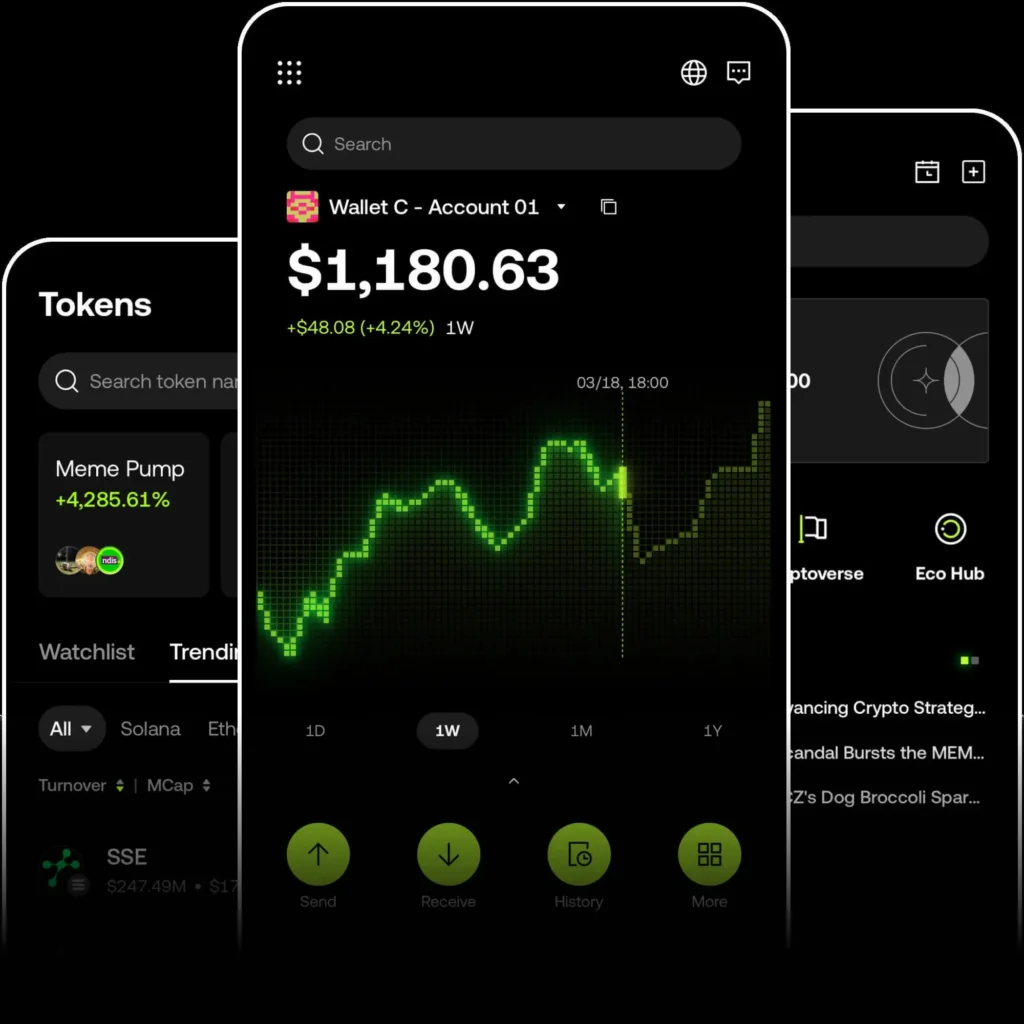
OKX’s mobile app combines biometric security, fast order execution, and an intuitive interface optimised for both casual users and active traders. This allows users to monitor markets, manage positions, and execute trades confidently from anywhere, without sacrificing performance or control.
Fees and Costs
OKX Australia publishes its own fee framework, which differs from OKX’s global fees.
- Spot trading fees: From 25 November 2025, the published regular-tier spot fee is 0.40% maker and taker on AUD and non-AUD pairs, with some zero-fee pairs.
- VIP tiers: Fees fall through nine VIP tiers based on trading volume and assets, for example to 0.25% maker and 0.30% taker on AUD pairs at VIP 1.
- Banking fees: AUD deposits by PayID and AUD withdrawals are generally free; check current terms.
- Card and third-party payments: Card or Apple and Google Pay purchases usually cost more, so compare the effective rate with a PayID deposit.
Fees change, so check OKX Australia’s current schedule for your account type before trading.
AUD Deposit/Withdrawal
OKX has built a local banking setup for Australian users.
- PayID/Osko: The main deposit method, usually credited within minutes.
- Apple & Google Pay: Card-style purchases through your phone, at a higher cost than PayID.
- Withdrawals: AUD withdrawals are sent to Australian bank accounts and usually arrive within hours.
For more experienced investors:
- SMSF accounts: OKX Australia offers accounts for self-managed super funds, with reporting for trustees and auditors.
- Staking (Earn): Staking products such as On-chain Earn let you earn rewards on assets like SOL and ETH. Rewards are generally ordinary income when received, as the ATO’s guidance on staking rewards explains.
- Trading bots: Trading bots such as grid and dollar-cost averaging bots automate buying and selling.
- Derivatives: Through OKX Australia Financial, eligible retail clients can trade USDT-margined perpetual futures with leverage of up to 2x and negative balance protection, after passing a suitability questionnaire and knowledge test, as its target market determination sets out. Even 2x leverage can produce rapid losses.
- OKX Pay: OKX says users can send stablecoins to other users by phone number or email, with no fee on its X Layer network.
Customer Support
Support at OKX combines automated efficiency with specialised human assistance, particularly for Australian users who require help with compliance heavy account structures or advanced platform features.
- Channels: 24/7 assistance is available through live chat and a full ticket based support system. Live chat handles general questions and urgent issues, while the ticket system is used for more complex cases such as verification reviews, withdrawal queries, and account security matters.
- Australian Team: OKX maintains a localised team in Sydney that supports Australian clients, especially those onboarding through SMSFs or corporate entities. This team often provides direct guidance on required documentation, compliance checks, and account structuring, which can significantly simplify what would otherwise be a complex process. Having local expertise helps ensure alignment with Australian regulatory and banking expectations.
- Self Help Resources: The OKX Learn portal contains hundreds of detailed educational articles and tutorials. These cover everything from beginner topics like how blockchain works, through to advanced trading concepts such as derivatives, risk management, and technical analysis strategies relevant to the modern crypto market. This makes it a valuable resource not just for troubleshooting, but for ongoing investor education.
Verification & KYC
Onboarding with OKX is built to be fast and frictionless while still meeting the strict compliance expectations of AUSTRAC. The process uses modern identity verification technology to ensure both speed and security for Australian users.
- Process: The entire verification procedure is completed digitally. Users upload their identification and complete a live selfie scan, which is analysed using AI driven facial matching. This confirms the person opening the account is the legitimate owner of the ID and helps prevent identity fraud or account misuse.
- Documents Required: Most Australian retail users can complete full verification using just an Australian Driver’s Licence or Passport. These documents allow access to core features, including deposits, trading, and withdrawals, without requiring additional paperwork in standard cases.
- Turnaround Time:
Retail account verification is often completed within minutes. Once approved, users can immediately deposit funds and begin trading, so you can get started quickly.
This streamlined process allows users to move from sign up to active trading very quickly, while still maintaining the compliance standards required for secure operation within the Australian financial system.
Pros & Cons
Pros
✅ Deep liquidity: Access to one of the world’s largest exchanges and its order books.
✅ Transparency: Monthly zk-STARK proof-of-reserves reports you can check yourself.
✅ Licensed derivatives: Retail perpetuals offered under an Australian financial services licence, with a 2x leverage cap.
✅ SMSF support: One of the few global exchanges with a dedicated Australian SMSF offering.
✅ Web3 integration: A built-in wallet for DeFi and NFTs.
Cons
❌ Fees for regular users: Published Australian spot fees of 0.40% are higher than OKX’s global fees and some local competitors’ order-book fees.
❌ Learning curve: Pro mode can be intimidating for users coming from simpler apps like CoinSpot.
❌ Custody risk: Like any exchange, funds held on OKX are in its custody.
Who is OKX Best For
- The Intermediate Investor: Someone who wants lower fees and better charts than a basic broker provides.
- SMSF Trustees: Trustees who need institutional custody and professional tax reporting for their super fund.
- Web3 Enthusiasts: Users who want to move assets between an exchange and decentralised apps without using multiple browsers or wallets.
- Active Day Traders: High-volume users who require deep order books and sophisticated trading bots.
How to Get Started
- Download & Register: Install the OKX app and create an account using your Australian mobile number or email.
- Verify Identity: Follow the prompts to scan your ID and complete the 3D face scan for instant KYC approval.
- Secure Your Account: Enable 2-Factor Authentication (2FA) and set up a Passkey for faster, more secure logins.
- Deposit AUD: Use the PayID details provided in the “Deposit” section to send funds from your bank.
- Execute a Trade: Use “Simple Mode” for your first buy, or head to the “Trade” tab to set a limit order for your preferred asset.
Final Verdict
OKX Australia combines the scale and tools of a global exchange with local AUD banking, AUSTRAC registration and an Australian financial services licence for its derivatives. It suits intermediate and active investors who want deep liquidity, advanced order types, SMSF support or Web3 access. Regular users should compare its published Australian fees carefully, and, as with any exchange, keep long-term holdings off the platform. Compare it with the other best crypto exchanges in Australia before deciding.