What is Crypto Staking? The Complete 2026 Australian Guide
Crypto staking is the process of locking up your digital assets to help support the operation and security of a blockchain network. It exists as the core mechanism for networks that use a “Proof of Stake” (PoS) system, replacing the energy-heavy “mining” process used by older blockchains like Bitcoin. In simple terms, staking is the digital equivalent of putting money in a term deposit to earn interest, but with a critical difference: your “deposit” is actually working as collateral to ensure that every transaction on the network is honest and accurate. This makes staking a vital tool for the 2026 investor who wants to earn a productive return on their holdings while contributing to the health of the decentralised economy.
Why Staking is Gaining Popularity in 2026
As the crypto market has matured over the years, the focus has shifted from simple price speculation to building sustainable, energy-efficient infrastructure. Staking matters because it allows the network to stay decentralised without requiring massive amounts of electricity. For you, the investor, it offers a way to offset inflation. Many blockchains create new tokens to reward those who secure the network; by staking, you ensure your share of the total supply isn’t diluted over time. In the current Australian market, staking has become a primary way for both retail and institutional investors to turn “idle” assets into a source of ongoing rewards.
How It Works: The Core Mechanisms
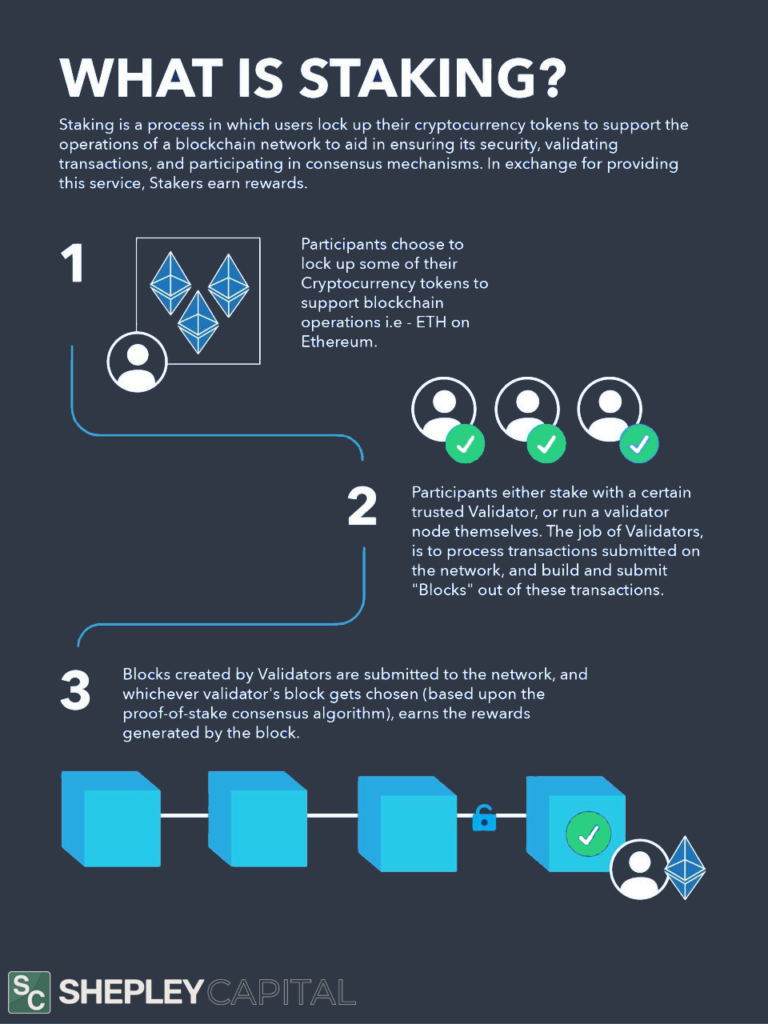
Staking operates through a system of “Validators” and “Delegators” who work together to maintain the ledger.
Validators and Nodes: A validator is a computer (or “node”) that has been authorised to check new transactions and add them to the blockchain. To become a validator, a person must “stake” a large amount of the network’s native token. This acts as a security bond. If the validator tries to cheat or makes a mistake, the network can “slash” (take away) a portion of their staked tokens as a penalty.
The Selection Process: Unlike mining, where the most powerful computer wins, Proof of Stake networks choose validators based on the size of their stake and the length of time they have held it. While the process involves an element of randomness to keep it fair, the more tokens staked, the higher the chance of being chosen to process a block and earn the associated rewards.
Reward Distribution: When a validator successfully processes a block of transactions, the network pays out a reward. If you are a “Delegator”; someone who has added their tokens to a validator’s pool, you receive a share of these rewards proportional to your contribution, minus a small commission fee charged by the validator for their technical work.
Where People Get Staking Wrong
The biggest mistakes in staking usually involve a misunderstanding of liquidity and the source of the “yield”:
The Liquidity Trap: Most staking requires a “lock-up” or “unbonding” period. This means if you decide to sell your tokens, you may have to wait anywhere from a few days to several weeks before you can access them. Investors often get caught when they need to sell during a market crash but their funds are still locked in a staking contract.
Chasing “Ghost” Yields: Some new or smaller projects offer incredibly high interest rates (e.g., 50% or more) to attract users. Often, these projects have poor Tokenomics, and the high inflation rate actually causes the price of the token to fall faster than the rewards are earned.
Ignoring Validator Quality: Not all validators are equal. If you delegate your tokens to a validator that is frequently offline or acts dishonestly, you could lose a portion of your funds through “slashing” penalties, even though you weren’t the one running the computer.
How to Approach Staking Correctly
To participate in staking like an experienced investor in 2026, you must move beyond the “set and forget” mindset. Approaching this correctly requires a disciplined framework that balances technical security, legal compliance, and financial efficiency. In the current Australian landscape, the difference between a successful staker and one who faces unnecessary losses is often found in the preparation stage; specifically, how you choose to interact with the network and how you manage your obligations to the state.
Choose Your Method Based on Your Needs
The first step is deciding where your “staking home” will be. There are three primary paths, each with a different balance of convenience and control:
- Centralised Exchanges (CEX): These are often the easiest entry point for beginners. The exchange manages the technical side for you, but in return, they take a percentage of your rewards and retain control of your private keys. (This same trade-off applies when using Centralised Exchanges (CEX) for Spot & Futures purposes)
- Staking Pools: These allow you to join forces with other holders to meet the minimum requirements for a validator. This is excellent for maintaining self-custody via your own wallet while still earning rewards.
- Liquid Staking: This has become a dominant trend in 2026. When you stake your tokens, you receive a “liquid” representative token (like stETH) in return. This allows you to earn staking rewards while still having a token you can use in other DeFi applications or sell quickly if you need liquidity.
Verify the Regulatory Status in Australia
The Australian regulatory environment is currently in a significant transition phase. As of early 2026, the Australian Securities and Investments Commission (ASIC) has introduced clearer guidelines for digital asset platforms. Many staking providers are currently operating under a “no-action” period that is set to conclude on 30 June 2026. This means you should prioritise platforms that are actively seeking Australian Financial Services (AFS) licensing or are compliant with the new Treasury frameworks. Using a compliant platform ensures that if something goes wrong, you have the backing of Australian consumer law and potential access to dispute resolution schemes. We talk more about the “Best crypto Exchanges in Australia” here.
Understand and Automate the Tax Implication
In the eyes of the Australian Taxation Office (ATO), staking rewards are not viewed as capital gains at the moment of receipt; they are treated as ordinary income. This is a critical distinction for your year-end planning. Every time a reward hits your wallet, it is as if you were paid a small salary in crypto. You must record the fair market value of that token in Australian Dollars at the exact time of receipt. This becomes your “cost base” for when you eventually sell the token, at which point Capital Gains Tax (CGT) rules will apply to any further profit. In 2026, using automated tax-tracking software that connects directly to your wallet is no longer optional, it is a requirement for professional-grade management. For a complete ATO Crypto tax guide for Australia, we highly recommend you visit “ATO Crypto Rules: What Every Aussie Investor Needs to Know”
Risks and Realities of Staking
Staking is frequently marketed as “passive income” or “free money”, but in the professional world of 2026, we recognise it as a service that carries specific, manageable risks. Understanding these trade-offs is what separates an informed participant from a speculator. When you stake, you are trading the immediate use of your capital for a reward; therefore, you must be aware of what can go wrong during that exchange.
Slashing Risk Slashing is the most direct penalty in a Proof of Stake network. Because your tokens act as a “bond” to ensure the network stays honest, that bond can be taken away if the rules are broken. If the validator you have chosen acts maliciously—or even if they simply experience a long period of technical “downtime” due to a poor internet connection, the network may “slash” a percentage of the total stake. This means a portion of your actual capital could be permanently removed. This is why choosing a validator with a high “uptime” record and a strong reputation is more important than simply finding the one with the lowest fees.
Volatility and Opportunity Risk It is vital to remember that a 5% staking reward is calculated in the native token, not in Australian Dollars. If the market price of the token drops by 20% while your funds are staked, your 5% reward will not protect you from an overall loss in purchasing power. Because most staking requires an “unbonding period” (a set number of days to unlock your funds), you may find yourself in a position where the price is falling rapidly, but you are unable to sell because your tokens are still locked in the contract. In 2026, “Liquid Staking” solutions have helped reduce this risk, but they introduce their own technical complexities.
Technical and Smart Contract Risk When you use a decentralised staking platform or a “Liquid Staking” protocol, you are placing your trust in code. Even if the project is legitimate, a “smart contract” is only as strong as its programming. If there is a hidden bug or a vulnerability in the code, a sophisticated hacker could drain the funds from the protocol. Unlike a traditional Australian bank account, there is no government-backed deposit insurance for DeFi protocols. Once funds are lost due to a technical exploit, they are almost always gone forever.
For a more detailed explanation of how to manage the risks of crypto staking & more, visit our “How to Manage Crypto Trading Risks” resource.
Final Thoughts
Staking is a fundamental shift in how we think about “owning” money. In the traditional world, your money sits in a bank and the bank earns the profit from using it. In the world of Proof of Stake, you are the one providing the service and you are the one earning the rewards. However, it should never be viewed as a “risk-free” way to grow your wealth. By diversifying your validators, understanding the unbonding periods, and staying up to date with the 2026 Australian tax and regulatory requirements, you can treat staking as a professional-grade component of your broader investment strategy. By understanding the mechanics and the risks involved, you can move from being a passive observer to an active, rewarded participant in the 2026 digital economy.
Frequently Asked Questions
What is crypto staking?
Crypto staking is the process of locking up your cryptocurrency to support the operations of a proof-of-stake blockchain network. In return, you earn staking rewards, which are typically paid in the same token you staked. Staking replaces the energy-intensive mining process used by Bitcoin. Ethereum, Solana, Cardano, and many other networks use proof-of-stake and allow holders to earn yield by staking their tokens.
How does proof-of-stake staking work?
In a proof-of-stake network, validators are chosen to create new blocks and verify transactions based on how much crypto they have staked. The more you stake, the higher your chance of being selected. Validators who behave honestly earn rewards. Validators who try to cheat can be penalised through slashing, where a portion of their staked funds is permanently destroyed. This economic incentive structure keeps the network secure without requiring massive computing power.
What is the difference between staking and yield farming?
Staking involves locking tokens to support a blockchain network's consensus mechanism and earning block rewards. Yield farming involves moving assets across DeFi protocols to maximise returns from liquidity provision, lending, and token incentives. Staking is generally simpler and lower risk. Yield farming can offer higher returns but involves more complexity, smart contract risk, and impermanent loss exposure. Both can be profitable, but they serve different purposes.
What are staking rewards and how much can you earn?
Staking rewards are new tokens distributed to validators and delegators for securing the network. Returns vary by network. Ethereum staking currently yields around 3-5% APY. Solana offers around 6-8% APY. Cosmos and Polkadot have historically offered 10-15% APY. Actual returns depend on the total amount staked on the network, validator commission rates, and token inflation. Higher yields often come with higher inflation or higher risk.
What is liquid staking?
Liquid staking lets you stake crypto while still being able to use it in DeFi. Platforms like Lido issue a derivative token (like stETH for staked Ethereum) that represents your staked position and accrues rewards. You can then use this derivative token in lending protocols or liquidity pools. Liquid staking solves the problem of illiquidity during lock-up periods but introduces smart contract risk and potential depeg risk between the derivative and the underlying asset.
Can you lose money staking crypto?
Yes. Even if your staking rewards are positive, if the token's price drops significantly, your overall position can be worth less in AUD terms than when you started. Validators running their own nodes risk slashing if they misbehave or go offline excessively. Lock-up periods mean you cannot sell during a price crash. Smart contract risk applies to liquid staking and delegated staking platforms. Always account for price risk alongside staking yield when evaluating returns.
How is staking taxed in Australia?
The ATO treats staking rewards as ordinary income at the time of receipt, taxed at your marginal tax rate. The AUD value is determined at the time each reward is received. When you later sell your staking rewards, capital gains tax applies to any increase in value since receipt. You must keep detailed records of every reward: date, amount received, and AUD value at receipt. Crypto tax software with staking integrations can significantly simplify this process.
How do you start staking crypto in Australia?
The easiest way to start staking in Australia is through a centralised exchange like Coinspot or Kraken, which offer staking directly in their apps with no technical setup. For more control and higher rewards, you can use a non-custodial wallet like Ledger or a staking platform to delegate to a validator yourself. For Ethereum, you need 32 ETH to run your own validator node, but liquid staking platforms like Lido allow you to stake any amount. Always research validator reliability and commission rates before delegating.