Capital Gains Tax for Cryptocurrency in Australia
What Are Capital Gains and Capital Losses?
FROM 1 JULY 2027, AUSTRALIA IS CHANGING ITS CAPITAL GAINS TAX RULES FOR A NEW 30% FLOOR TAX & INTEREST TAX. THESE CHANGES CAN BE VIEWED IN DETAIL HERE.
In Australia, Capital Gains Tax (CGT) applies whenever you sell, swap, or otherwise dispose of a crypto asset. This includes trading one coin for another, selling for fiat, or using crypto to buy goods or services.
- A capital gain occurs when your crypto’s sale price exceeds your cost base (what you originally paid for it, including fees).
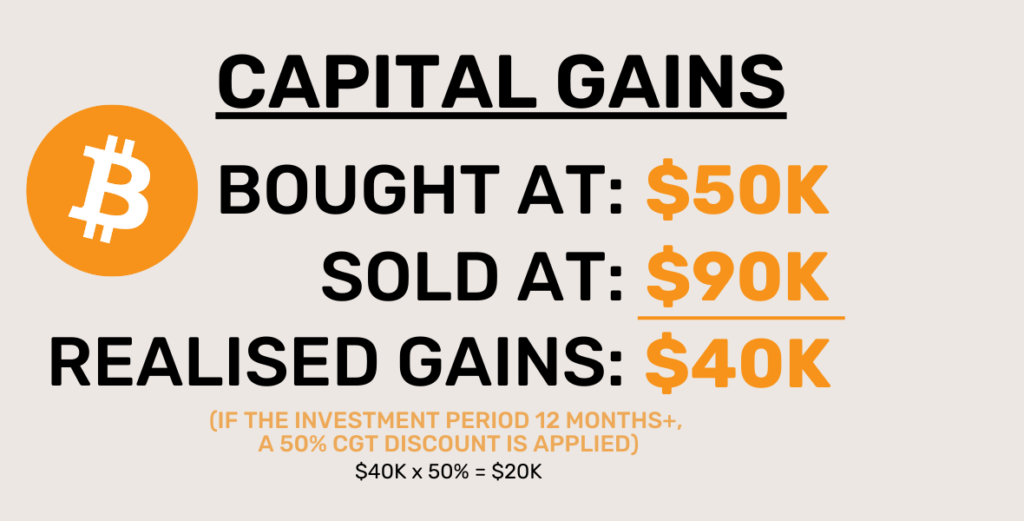
EG: Bought one Bitcoin at $50K. Price rises to $90K per one Bitcoin. You sell your entire one Bitcoin, resulting in a $40k realised Capital Gain (Profit). That $40k is Taxable.
- A capital loss occurs when your sale price is less than your cost base.
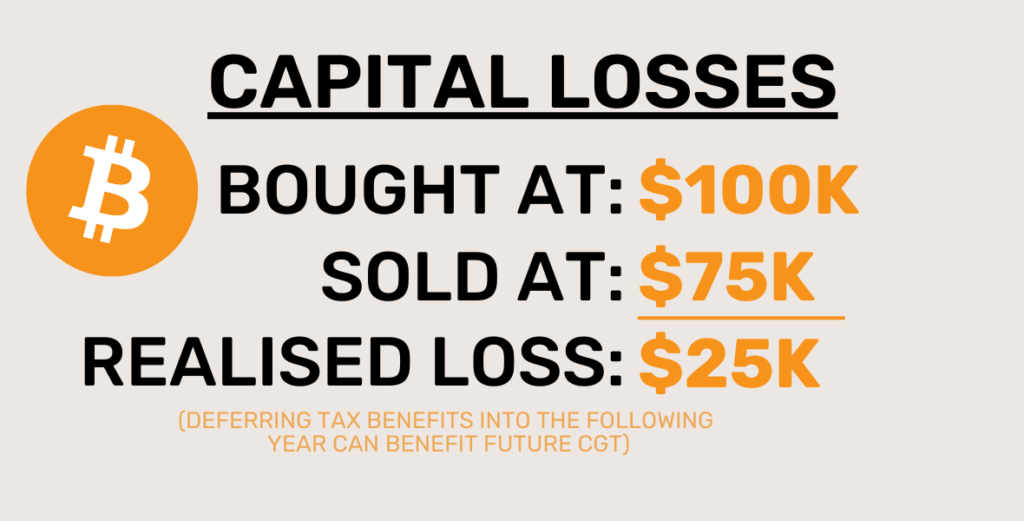
EG: Bought one Bitcoin at $100K. Price falls to $75K per one Bitcoin. You sell your entire one Bitcoin, resulting in a $25k realised Capital Loss (Net Loss). That $25k is a tax reducing event (Deferred tax benefits towards future CGT).
As at the time of writing this resource (October 2025), the Australian Tax Office (ATO) treats crypto as an asset, not a currency, meaning every transaction that disposes of crypto can create a taxable event.
The Key to Managing Crypto Tax: Strategic Realisation
Understanding when to realise a loss or a gain is critical. In a volatile market, you can use these movements to your advantage.
Let’s look at the example:
You buy 1 BTC at $100,000.
BTC falls to $50,000.
You sell 1 BTC for $50,000, creating a capital loss of $50,000.
You instantly buy back 1 BTC for $50,000.
Now your tax record shows:
- A $50,000 realised capital loss.
- No taxable gain on the repurchase (since it’s a new acquisition).
This capital loss can be offset for a number of years, remaining a useful tax tool for future CGT minimisation.
If BTC later rises to $120,000 and you sell:
- You’ll have a capital gain of $70,000 ($120,000 – $50,000).
- But you can offset that gain with the $50,000 loss you previously realised.
Effectively, you only pay CGT on the net $20,000 gain, not the full $70,000.
Compounding as a tax tool, CGT in Australia is also decided by the duration of which you hold your untouched assets. If you hold your purchased Bitcoin for less than a 12 month period, your entire profits are subject to CGT. However, if you purchased Bitcoin over 12 months ago, your profits would qualify for a 50% CGT discount, essentially halving the taxable profits.
Lets play out this scenario of a corporate employee who invests on the side:
Purchase & Sale Details
- Purchase price (cost base): $100,000
- Sale price (capital proceeds): $150,000
- Capital gain (before discount): $150,000 – $100,000 = $50,000
Holding Period
The Bitcoin investment was held for 1.5 years (18 months).
As that is longer than 12 months, the investor qualifies for the 50% CGT discount (for individuals and trusts).
Apply the 50% CGT Discount
- Discounted capital gain: $50,000 × 50% = $25,000
So, the taxable capital gain is now $25,000
Tax Payable Depends on Your Income Bracket
The discounted gain ($25,000) is added to the investor’s taxable income for the year and taxed at their marginal income tax rate.
For 2025/26, the Australian individual tax brackets (excluding 2% Medicare levy) are as follows:
16c for each $1 over $18,200
$4,288 plus 30c for each $1 over $45,000
$31,288 plus 37c for each $1 over $135,000
$51,638 plus 45c for each $1 over $190,000
The Key to Managing Crypto Tax: Strategic Realisation
Here’s how you can maximise tax benefits legally and effectively:
Offset current-year gains:
If you made gains earlier in the year (e.g., from selling ETH, stocks, or property), realise strategic losses before June 30 to offset them.
Carry forward losses:
If you have no gains this year, you can carry capital losses forward indefinitely to reduce future taxable gains.
Long-term holding discount:
If you hold crypto for 12 months or more before selling, individuals can get a 50% CGT discount on gains. This doesn’t apply to companies.
Keep clean records:
The ATO requires detailed records for every trade, including:
- Dates of acquisition and disposal
- Cost base and sale proceeds
- Transaction fees
- Purpose of the transaction (investment, personal use, etc.)
Use crypto tax software or spreadsheets to maintain accuracy.
(COMING SOON | Shepley Capital Investment Tax Calculator)
Example Scenarios of CGT
Here are a few bonus scenarios to help you understand the concept of CGT:
Scenario 1 – Tax-Loss Harvesting Mid-Year:
You bought 2 ETH at $5,000 each ($10,000 total).
ETH drops to $3,000 each ($6,000 total).
You sell both for $6,000 and immediately buy back 2 ETH.
Result: $4,000 realised capital loss.
You can use that to offset other capital gains that year.
Scenario 2 – Long-Term Investor:
You bought 1 BTC at $40,000 in 2021.
You sell at $80,000 in 2024 after 3 years.
Your gain is $40,000, but with the 50% CGT discount, you only pay tax on $20,000.
Scenario 3 – Portfolio Rebalancing:
You decide to exit a poorly performing altcoin and rebalance into BTC.
You sell the altcoin at a loss, realise a deductible capital loss, and reinvest in a more stable asset.
Final Notes for CGT Regulations in Australia
- Crypto-to-crypto trades are taxable events in Australia. Swapping ETH for BTC still triggers CGT.
- Using crypto to buy goods or services also triggers a disposal.
- You cannot offset capital losses against ordinary income (like wages). Only against capital gains.
- Losses from theft or scams may also be claimable if properly documented.
This article is for educational purposes only and does not constitute financial or tax advice. Australian crypto tax law is complex and subject to change; consult a registered tax agent or accountant regarding your specific circumstances before making any decisions.
Frequently Asked Questions
Do you pay capital gains tax on crypto in Australia?
Yes. The ATO treats cryptocurrency as a capital asset, so capital gains tax (CGT) applies when you dispose of it. Disposal includes selling for AUD, trading one crypto for another, spending crypto on goods or services, or gifting crypto. CGT is calculated on the difference between the sale proceeds and the cost base (what you paid for it). If you held the asset for more than 12 months, you are eligible for the 50% CGT discount.
How is crypto capital gains tax calculated in Australia?
The capital gain is calculated as: proceeds (sale price in AUD) minus cost base (purchase price in AUD plus associated costs such as exchange fees). If the result is positive and you held for over 12 months, you apply the 50% CGT discount to reduce the taxable gain. The remaining amount is added to your assessable income and taxed at your marginal rate. If the result is negative, you have a capital loss, which can offset other gains.
What is the 12-month CGT discount for crypto in Australia?
If you hold a cryptocurrency for more than 12 months before disposing of it, you are entitled to a 50% CGT discount as an individual. This means only half of your capital gain is included in your assessable income. For example, if you bought Bitcoin for $10,000 AUD and sold it 18 months later for $30,000 AUD, your gross gain is $20,000. The 50% discount reduces this to $10,000, which is then taxed at your marginal rate.
Which crypto transactions trigger a CGT event?
CGT events are triggered by: selling crypto for AUD, swapping one cryptocurrency for another, spending crypto to buy goods or services, gifting crypto to another person, and in some circumstances, losing access to crypto permanently. Transferring crypto between your own wallets does not trigger a CGT event. Receiving crypto (from staking, mining, or as payment) is an income event, not a CGT event at the time of receipt, but will trigger CGT when those received tokens are later disposed of.
Can I reduce my crypto capital gains tax in Australia?
Yes, legitimately. Holding for over 12 months unlocks the 50% CGT discount. Offset gains with capital losses from the same or previous years. Add all acquisition costs to your cost base (exchange fees, brokerage, gas fees at time of purchase) to increase it and reduce your gain. Time disposals to years when your income is lower, reducing your effective marginal rate. Contribute to superannuation to reduce your taxable income. Always work with a registered tax agent for personalised advice.
Is gifting crypto a CGT event in Australia?
Yes. Gifting crypto to another person is treated as a disposal at market value on the date of the gift. If the market value is higher than your cost base, you have a capital gain. If it is lower, you have a capital loss. The recipient's cost base for their own future CGT calculation is the market value on the date they received the gift. Gifting crypto to a spouse or charity has specific rules, so professional advice is recommended.
Do I pay CGT if I transfer crypto between my own wallets?
No. Transferring crypto between wallets you own is not a disposal and does not trigger a CGT event. This includes moving crypto from an exchange to a hardware wallet, or between two self-custody wallets you control. However, you must keep clear records proving that both wallets belong to you. The cost base and acquisition date of the asset remain unchanged through internal transfers.
What CGT rate do I pay on crypto gains in Australia?
There is no separate CGT rate in Australia. Your crypto capital gains are added to your taxable income and taxed at your marginal income tax rate. For 2025-26, tax rates range from 0% (up to $18,200 AUD) to 45% (above $180,000 AUD), plus the 2% Medicare levy. If you qualify for the 50% CGT discount, only half your gain is added to income. The effective tax rate on your crypto gain depends on your total income for the year.