
FUNDAMENTALS OF CRYPTO

What is a Crypto Whitepaper: The Complete 2026 Guide for Beginners
In the fast-moving world of digital finance, the whitepaper remains the most important document for any serious investor to understand. Despite its over-generalised nature, the whitepaper is far more than just a marketing brochure; it’s the comprehensive blueprint that outlines the technical, financial, and philosophical foundations of a cryptocurrency project.
Every major breakthrough in the industry, from Bitcoin to the latest 2026 DeFi protocols, started as a whitepaper designed to persuade developers and investors of a new way to solve a problem.
Unlike a company prospectus in traditional finance, a crypto whitepaper is not a legally regulated document. Any project can publish one regardless of the quality of the underlying technology or the credibility of the team. This means the whitepaper serves as a research starting point rather than a guarantee of legitimacy. A well-written whitepaper with credible technical detail and transparent tokenomics is a positive signal. An absent whitepaper, a vague one, or one that makes claims without technical substance is a significant red flag that warrants serious caution before investing.
What exactly is a Crypto Whitepaper?
A crypto whitepaper is the authoritative report that explains a project’s purpose and its underlying technology in exhaustive detail. In 2026, where regulatory clarity has increased, these documents have evolved from simple PDFs into interactive, living repositories of information that serve as the project’s primary source of truth.
Think of it as a hybrid between a high-level business plan, a rigorous academic paper, and a technical user manual. Its job is to provide enough detail so that an expert can verify the code’s logic while an investor can understand the economic potential.
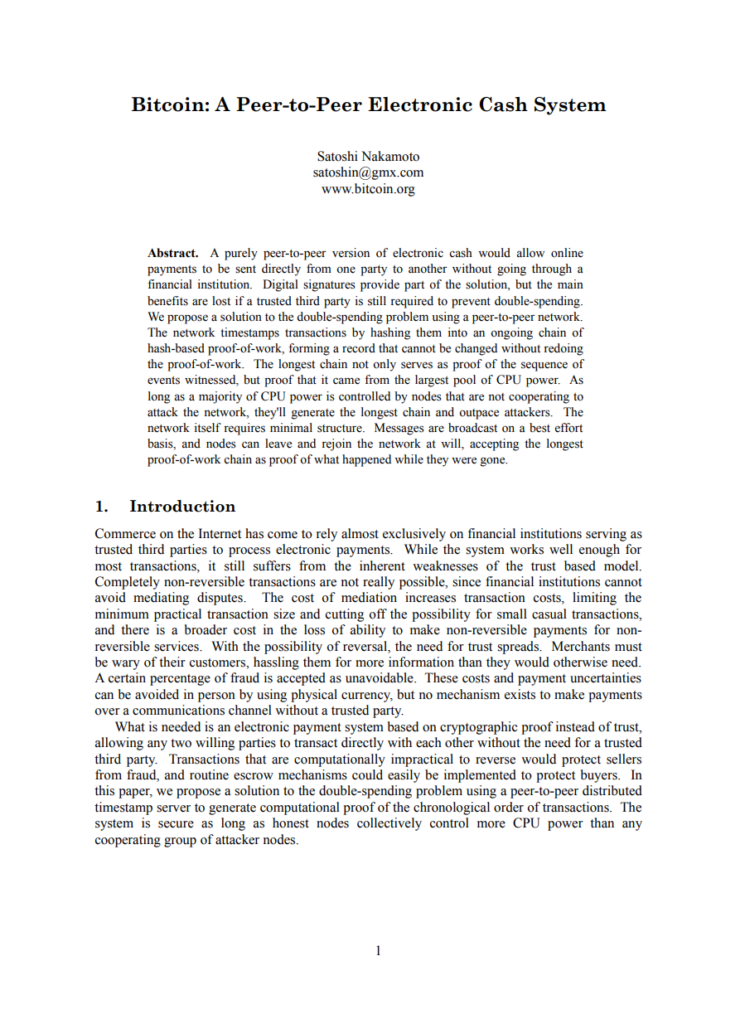
The original and most influential crypto whitepaper is the Bitcoin whitepaper published by Satoshi Nakamoto in 2008, titled “Bitcoin: A Peer-to-Peer Electronic Cash System.” At just nine pages, it outlined a complete decentralised payment system that required no trusted third party. Ethereum’s whitepaper, published by Vitalik Buterin in 2013, expanded the concept to a general-purpose programmable blockchain. These two documents established the template for what a credible crypto whitepaper looks like: a clear problem statement, a specific technical solution, and transparent mechanics for how the system operates.
What key information does a Whitepaper hold?
Most legitimate projects follow a standardised structure to ensure they provide the transparency that the 2026 market demands. By analysing these specific sections, you can peel back the hype and see if the project has a sustainable future or if it is built on shaky foundations.
- The Problem & Solution: The document must clearly articulate a specific “pain point” in the current financial or digital landscape. It then explains exactly how its blockchain technology solves that problem more efficiently than existing centralized systems.
- Technical Architecture: This is the “how-to” section that describes the consensus mechanism (how nodes agree on the truth), the network security protocols, and the scalability solutions. It often includes complex diagrams and mathematical formulas to prove the system works.
- Tokenomics (Token Economics): This is perhaps the most critical section for an investor. It details the total supply of the coin, how the tokens are distributed among the team and the public, the “vesting” periods (when the team is allowed to sell), and how the token creates value within the ecosystem.
- The Roadmap: This section provides a timeline of past achievements and future milestones. It allows you to track whether the developers are meeting their deadlines and if they have a realistic plan for the next several years.
- The Development Team: Reputable whitepapers provide verified backgrounds of the founders and lead developers. In the current 2026 landscape, a “doxxed” (transparent) team is often a requirement for a project to be taken seriously by major exchanges.
Where can you find a Whitepaper?
Locating a whitepaper is generally straightforward, as projects are eager to get their documentation into the hands of potential users. Because transparency is now a core pillar of the industry, you can find these documents through several trusted channels.
- The Official Project Website: Almost every project will have a link labeled “Whitepaper,” “Docs,” or “Technical Paper” in its main navigation or footer.
- Market Aggregators: Websites like CoinGecko or CoinMarketCap list a direct link to the whitepaper in the “Links” section of every individual coin’s page.
- GitHub: For open-source projects, the whitepaper is often stored in their public code repository, allowing you to see the original version and any subsequent updates.
- Exchange Research Portals: Many Australian exchanges now provide their own summaries and direct links to whitepapers as part of their educational “deep dive” sections.
Why Whitepaper's matter in 2026
Reading a whitepaper is the ultimate form of “DYOR” (Do Your Own Research). In an era where social media trends can move markets in seconds, the whitepaper remains the only place where the fluff is stripped away and the cold, hard logic of the project is laid bare. If a project refuses to provide a clear, detailed whitepaper, it is usually a major red flag that the project lacks substance.
Investor Tip: If the whitepaper is too technical, look for a “Litepaper.” Many modern projects release these shorter, more visual versions that explain the same concepts using less jargon, making them much easier for retail investors to digest.
When reading a whitepaper, focus on four areas. First, the problem statement: is the problem being solved real and significant, or is it manufactured to justify a token? Second, the technical solution: does the proposed approach actually solve the problem, or is it vague and jargon-heavy without substance? Third, the tokenomics: what is the total supply, how is it distributed, what are the vesting schedules for team and investor allocations, and what gives the token its value within the protocol? Fourth, the team: are the authors identified, do they have verifiable credentials, and have they delivered on projects before? A whitepaper that passes these four tests clears the minimum bar for further research.
WRITTEN & REVIEWED BY Chris Shepley
UPDATED: MAY 2026
Choose your next topic from our Cryptopedia








