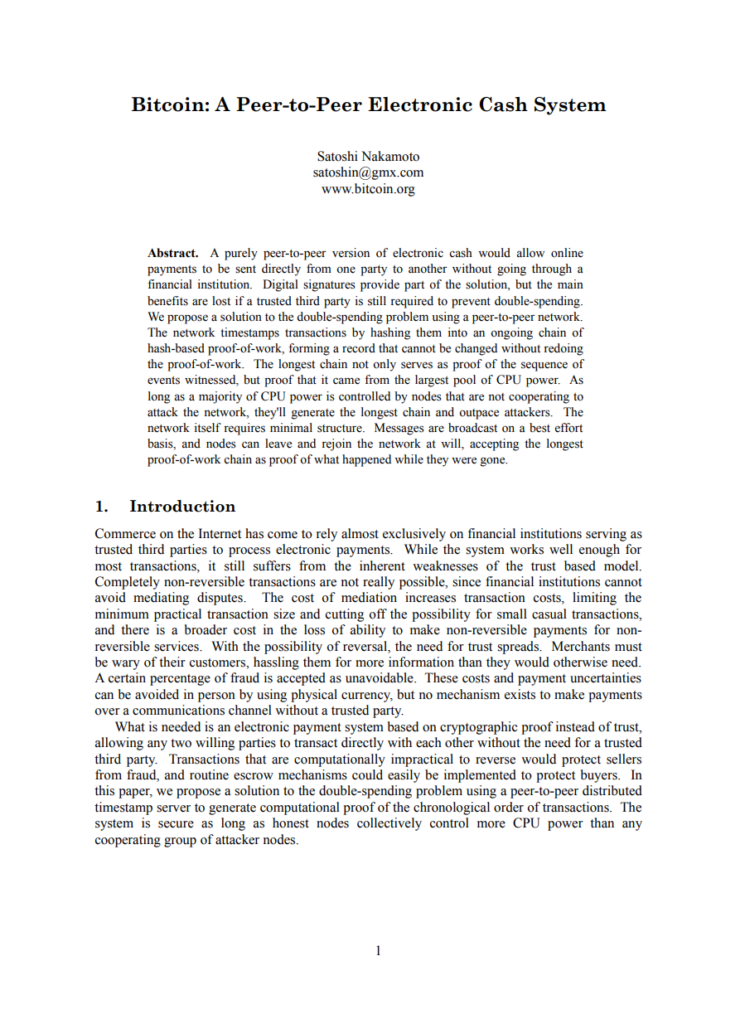
In the fast-moving world of digital finance, the whitepaper remains the most important document for any serious investor to understand. Despite its over-generalised nature, the whitepaper is far more than just a marketing brochure; it’s the comprehensive blueprint that outlines the technical, financial, and philosophical foundations of a cryptocurrency project.
Every major breakthrough in the industry, from Bitcoin to the latest 2026 DeFi protocols, started as a whitepaper designed to persuade developers and investors of a new way to solve a problem.
Unlike a company prospectus in traditional finance, a crypto whitepaper is not a legally regulated document. Any project can publish one regardless of the quality of the underlying technology or the credibility of the team. This means the whitepaper serves as a research starting point rather than a guarantee of legitimacy. A well-written whitepaper with credible technical detail and transparent tokenomics is a positive signal. An absent whitepaper, a vague one, or one that makes claims without technical substance is a significant red flag that warrants serious caution before investing.
Reading the Tokenomics Section Without Being Sold To
The article above calls tokenomics the most important section for an investor. It is, and it is also the section written to be skimmed. Four numbers decide most of what you need to know.
Total supply against circulating supply. A token trading at a modest price with 8% of supply circulating is not cheap. It is early, which is a different thing entirely. The gap between the two figures is the supply still due to arrive. Max supply versus circulating supply covers why the distinction changes the valuation.
Allocation. Who received tokens before the public did, and at what price. A team and investor allocation of 40% or more means the people holding the largest positions paid a fraction of what you will. That is not automatically disqualifying, but it tells you who is early and who is exit liquidity.
Vesting and unlock schedule. The date insiders are first able to sell, and the rate at which supply arrives after that. A whitepaper that describes allocation but never states a vesting schedule has left out the part that determines price behaviour for the next two years.
What the token actually does. A token needs a reason to be held rather than sold on receipt. Fee capture, staking, governance with real authority, or collateral use are reasons. “Powers the ecosystem” is not. Tokenomics covers the mechanics in full, and the market capitalisation guide covers how supply figures feed the headline valuation.
Read those four together rather than separately. Generous allocation plus short vesting plus no reason to hold the token is a coherent picture, and not a flattering one.
The Claims a Whitepaper Cannot Verify
A whitepaper is written by the project. That single fact governs how much weight any of it can carry.
It is not a prospectus, it carries no regulatory obligation to be accurate, and nobody audits it. A whitepaper is a statement of intent, and intent is the cheapest thing in the industry to produce. Treat it as the claim, not the evidence.
Several things in a whitepaper simply cannot be confirmed from the document itself. Whether the code described actually exists and does what the prose says. Whether the named team members are real, and whether they consented to being listed. Whether the partnerships mentioned are commercial agreements or a logo lifted from a public website. Whether the roadmap dates have any engineering behind them.
Each of those is checkable, just not here. The code lives in a public repository. Team claims can be checked against professional profiles and prior projects. Partnerships can be confirmed by asking the partner. This is the ordinary work of doing your own research, and the whitepaper is where it starts rather than where it finishes.
The specific document to be sceptical of is the polished one with no technical substance. Heavy design, confident language, market-size projections, and nothing a developer could implement from. Scarcity language and guaranteed returns belong to a different category again: those are the markers of a pyramid scheme rather than a project, and no amount of blockchain vocabulary changes that.
From Whitepaper to Decision: What Else to Check
A whitepaper that survives a careful read has cleared the lowest bar, not the last one. Several checks sit outside the document and matter more.
Does the chain it runs on suit the design? A project promising high-frequency consumer transactions on a network with high fees has a problem it cannot write its way out of. Gas fees and the Layer 1 versus Layer 2 distinction settle most of this quickly.
Has the contract been audited, and by whom? An audit is not a guarantee, and an unaudited contract holding user funds is a decision rather than an oversight. Our smart contract audit guide covers what an audit does and does not tell you.
How would you buy it, and how would you leave? Thin liquidity is its own risk, and it shows up on the way out rather than on the way in. Where a token trades, and how much of its volume sits on one venue, is worth knowing before you hold it. A token available only on a decentralised exchange with a shallow pool can be bought easily and sold only at a price you will not like.
What does it cost you in Australia? Buying a token is a CGT event when you eventually dispose of it, and swapping into it from another asset is a disposal of that asset. The Australian crypto tax overview covers the framework.
The purpose of reading a whitepaper is not to become convinced. It is to find the specific claim that, if false, breaks the whole thing, and then to go and check that claim somewhere else.
Whitepaper Red Flags Worth Naming
A handful of patterns recur often enough to be recognisable on sight. None of them need technical skill to spot.
- Guaranteed or fixed returns. No credible protocol paper promises a rate, because no protocol controls the market. Fixed daily or monthly returns are the language of Ponzi structures.
- Rewards for recruiting. If the document describes referral tiers as a way to earn, the token is incidental to the structure.
- An anonymous team holding a large allocation. Anonymity alone is not disqualifying, and anonymity combined with 40% of supply is. Red flags in new crypto projects covers the wider set.
- Liquidity the team can remove. Where the paper is silent on whether liquidity is locked, assume it is not. That is the mechanism behind a rug pull.
- Yield with no stated source. A staking return has to be paid by someone. Papers that describe the reward and never the source are describing a fake staking platform.
- Manufactured urgency around the launch. Countdowns and tiered allocation windows exist to stop you reading carefully, which is exactly how fake token launches work.
The document itself also tells you something by what it assumes you already know. A paper written for altcoin buyers with no technical section, no consensus discussion, and no account of how nodes reach agreement is a marketing asset with a technical costume. Compare it against a paper that does the work, such as Ethereum’s case for programmable smart contracts, and the gap is obvious. Researching altcoins covers the checks that follow.
Reading a whitepaper is the ultimate form of “DYOR” (Do Your Own Research). In an era where social media trends can move markets in seconds, the whitepaper remains the only place where the fluff is stripped away and the cold, hard logic of the project is laid bare. If a project refuses to provide a clear, detailed whitepaper, it is usually a major red flag that the project lacks substance.
Investor Tip: If the whitepaper is too technical, look for a “Litepaper.” Many modern projects release these shorter, more visual versions that explain the same concepts using less jargon, making them much easier for retail investors to digest.
When reading a whitepaper, focus on four areas. First, the problem statement: is the problem being solved real and significant, or is it manufactured to justify a token? Second, the technical solution: does the proposed approach actually solve the problem, or is it vague and jargon-heavy without substance? Third, the tokenomics: what is the total supply, how is it distributed, what are the vesting schedules for team and investor allocations, and what gives the token its value within the protocol? Fourth, the team: are the authors identified, do they have verifiable credentials, and have they delivered on projects before? A whitepaper that passes these four tests clears the minimum bar for further research.