

Institutions are Beginning to Integrate Stablecoins
Back to Free Resources Institutions are Beginning to Integrate Stablecoins REVIEWED BY Chris Shepley UPDATED: MARCH 2026 Stablecoin Integration is Kicking off In the second half

WRITTEN & REVIEWED BY Chris Shepley
UPDATED: MARCH 2026
We’re no longer speculating about the AI era. We are living through its ignition phase where artificial intelligence is beginning to replace analysis, execution, research, coordination, and increasingly, independent decision making. The recent OpenClaw push toward autonomous AI agents operating 24 hours a day signals something far more significant than incremental progress. It signals completeness. AI is moving from tool to operator.
We are entering the AI Age of civilisation. And every civilisation shift is defined by infrastructure.
– The Industrial Age needed oil and steel.
– The Internet Age needed fiber and servers.
– The AI Age needs power and speed.
The Power Is Being Built.
Think about your own computer: to open a document, run a search, or load a game, thousands of micro processes execute simultaneously. Every click triggers layered instructions.
Now scale that to hundreds of millions of AI agents operating around the clock. Agents trading, negotiating contracts, managing supply chains, executing micro payments, coordinating logistics, and running entire businesses. That scale demands extraordinary computational energy. Companies like Nvidia & AMG are building that foundation, supplying the chips that power modern data centers and large scale AI models. Compute is scaling aggressively.
But compute alone is not enough. AI does not just think. It transacts. Every autonomous agent interacting with the real economy must send payments, validate data, record ownership, update contracts, and confirm state changes. That means transactions at machine speed. And this is where the structural bottleneck emerges.
Current blockchain infrastructure was not designed for machine scale commerce. Bitcoin processes roughly 7 transactions per second. It was engineered for security and decentralisation, not high frequency execution. Ethereum handles approximately 15 to 30 transactions per second on its base layer. Layer two solutions improve throughput, but base layer limitations remain significant. Ripple is often cited for speed and can process around 1,300 transactions per second. That is materially faster, yet still negligible relative to what a fully autonomous AI economy would require.
The real question is not whether these numbers are impressive relative to legacy systems. The real question is what is enough. If 100 million AI agents each execute only 10 transactions per minute, that equates to 1 billion transactions per minute, or over 16 million transactions per second… and that’s only a conservative estimate in a world where agents negotiate in milliseconds.
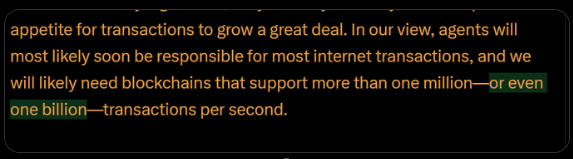
Leadership at Stripe has openly discussed how AI agents will require financial rails capable of supporting millions of transactions per second, potentially scaling toward the billion TPS range over time. Machine economies operate at machine velocity. Human speed is irrelevant.
Very few blockchains even claim throughput above 100,000 transactions per second, and even fewer approach 300,000 TPS in controlled environments.
And almost none architecturally target the million to billion TPS threshold required for full AI-scale adoption.
This is where emerging high-throughput architectures enter the conversation.
One of the few networks explicitly designed around extreme scalability is Keeta Network, which positions itself around ultra high throughput architecture, targeting hundreds of thousands of transactions per second with long term scalability toward significantly higher ranges. Whether any network can sustainably deliver those figures under real world decentralisation constraints remains to be validated. However, the direction of travel is undeniable.
Whether any network can truly sustain those numbers under real-world decentralization constraints remains to be proven. But the direction is clear.
The AI Age forces a throughput revolution. Compute without transaction rails is intelligence without action. If autonomous agents cannot settle value, execute agreements, or coordinate state changes instantly, the system collapses under friction. Blockchain was originally designed to serve human finance. It may ultimately be required to serve machine finance. Machines do not tolerate congestion, latency, or settlement delays.
History shows that infrastructure always trails innovation at first. Early internet bandwidth constrained digital media. Streaming services were once crippled by buffering. Cloud computing faced cost barriers before scale efficiencies emerged. AI will face a similar bottleneck in transaction throughput. Capital will inevitably flow toward whatever infrastructure can remove that constraint.
The defining question of the next decade is not whether AI transforms civilisation…
It is which digital transaction layer can sustain civilisation at machine scale.
Back to Free Resources Institutions are Beginning to Integrate Stablecoins REVIEWED BY Chris Shepley UPDATED: MARCH 2026 Stablecoin Integration is Kicking off In the second half