
46 Days of Fear, But the Smart Money Is Moving | Capital Nexus - By Shepley Capital
Welcome to the latest edition of Capital Nexus – Shepley Capital’s crypto newsletter.
The Era of the 'Grey Zone' Ends: Australia’s Digital Asset Framework Moves to Final Vote
The Australian Senate Economics Legislation Committee this week officially recommended that the Corporations Amendment (Digital Assets Framework) Bill 2025 proceed to a full Senate vote. This marks the clearance of the final major parliamentary hurdle before the most significant overhaul of Australia’s financial services laws in a generation becomes law.
The Bill brings digital asset intermediaries—including exchanges, custody providers, and brokerage services—directly into the regulatory light. Under the new framework, these entities will be required to hold an Australian Financial Services Licence (AFSL) with specific new authorisations for Digital Asset Platforms (DAPs) or Tokenised Custody Platforms (TCPs).
While earlier discussions hinted at a bespoke “DASL” licence, the government has ultimately chosen to integrate these requirements into the existing AFSL regime. This ensures that crypto platforms are held to the same “bank-grade” standards as traditional financial institutions, including strict requirements for asset segregation, minimum capital reserves, and robust dispute resolution via AFCA.
The clock is now ticking for the industry. Once the Bill receives Royal Assent—expected in late April or May 2026—a 12-month commencement period will begin. Following that, existing operators will have a 6-month transition window to lodge their AFSL applications. For major local players like CoinSpot, Swyftx, and Independent Reserve, the path is clear, but the “6-month sprint” poses a existential threat to smaller operators who lack the capital or legal infrastructure to meet these rigorous compliance standards.
For the Australian investor, this is a watershed moment. By treating digital asset facilities as formal financial products, the government is creating the “safe harbour” necessary for institutional capital and superannuation funds to enter the market with full legal certainty. The message is clear: the wild west is over, replaced by a licensed, supervised, and professionalized marketplace.
The full article can be found here: Corporations Amendment (DAF) Bill 2025.
The 20 Millionth Bitcoin Was Mined Last Week
Bitcoin’s 20 millionth coin was mined last week, leaving just 1 million BTC remaining to ever enter circulation. Of the 21 million hard-capped total supply, 95.2% has now been issued.
The rate at which the remaining supply is released is determined by the halving schedule. After the April 2024 halving, miners receive 3.125 BTC per block. The next halving, expected around 2028, will reduce this to 1.5625 BTC. At current block times, the final Bitcoin will be mined sometime around the year 2140.
As miner rewards decline, transaction fees become the primary revenue source for network security, a transition already underway at the margin. For investors focused on supply-side dynamics, the 20 million milestone illustrates what makes Bitcoin structurally different from every other asset class: verifiably finite, mathematically enforced scarcity with a public issuance schedule that cannot be altered without consensus from the entire network.

Bitcoin Dominance at 58% - Altcoin Season Still Not Here
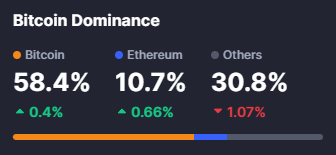
Bitcoin’s share of total crypto market capitalisation rose to 58% this week, its highest level since January 2026. The Altcoin Season Index sits at 35 out of 100, firmly in Bitcoin Season territory, where BTC is outperforming the majority of the top 50 altcoins over the trailing 90 days.
Historically, altcoin seasons follow Bitcoin runs with a lag. Capital flows from fiat into Bitcoin first, then rotates into large-cap altcoins, and finally into smaller caps. That rotation typically requires Bitcoin to be in a stable or upward range, not the consolidation phase the market is currently experiencing.
Ethereum continues to underperform relative to Bitcoin this cycle, with ETH/BTC near multi-year lows. For Australian investors building diversified crypto portfolios, the current market structure favours Bitcoin allocation while waiting for clearer signals of a rotation into altcoins.
Legal Risks of Crypto Investing in Australia - Cryptopedia Snippet
With the Corporations Amendment (Digital Asset Framework) Bill 2025 now cleared by the Senate committee, the Australian regulatory landscape is shifting faster than most investors realise. Understanding the current legal framework and what changes when the new licensing regime takes effect is essential for anyone with meaningful crypto exposure.

Learn the ATO Crypto Rules that every Aussie Investor needs to know here.
See you next volume.
~ Chris Shepley
Founder of Shepley Capital